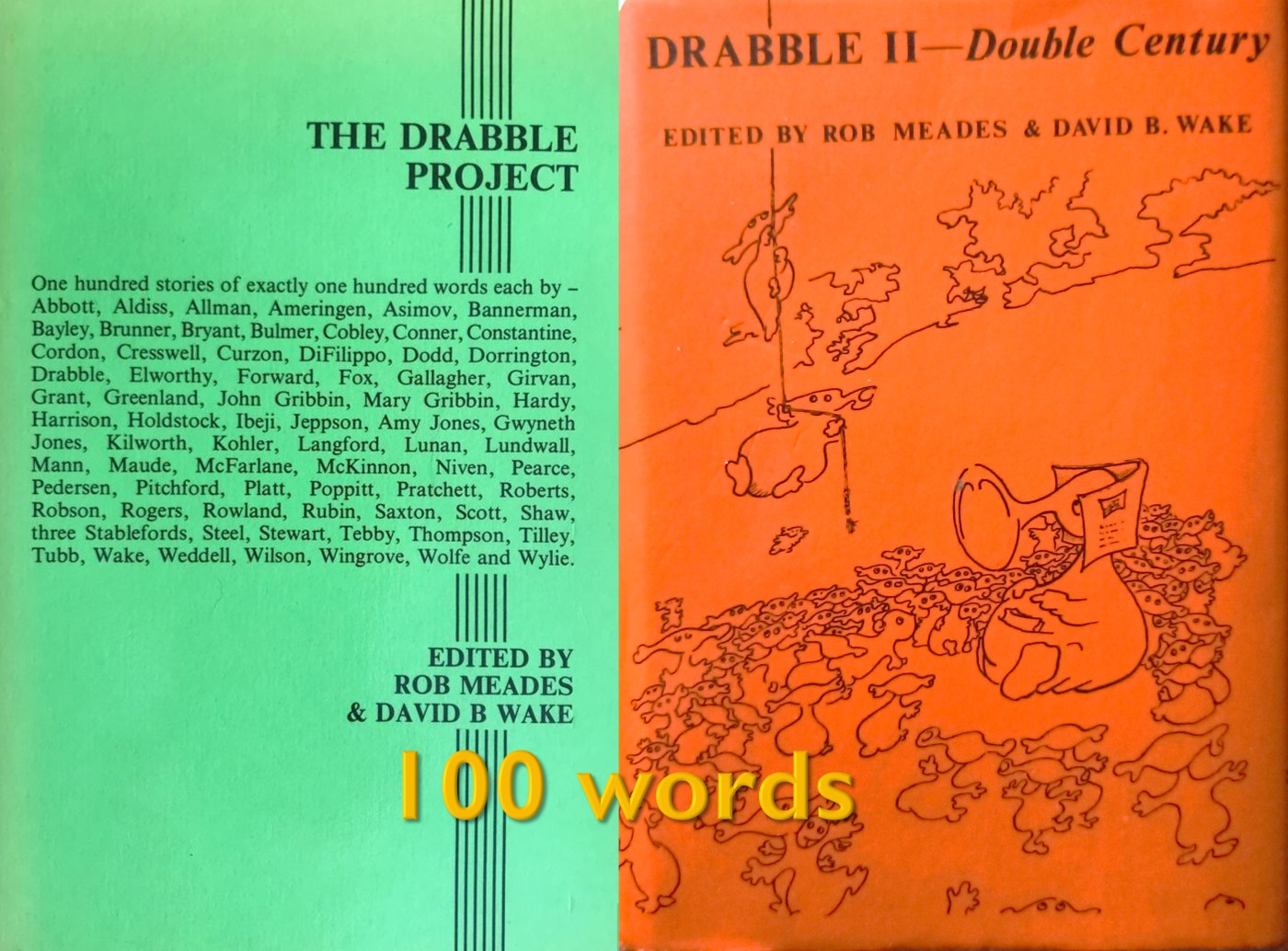
A drabble is a micro fiction of 100 words. A dribble is a micro fiction of 50 words.
Those might seem like difficult and fussy limitations for a story, but they’re not impossible. The real trick is to encapsulate a satisfying plot arc before the fiftieth or hundredth word. A challenge but, if you succeed, it can feel oddly exhilarating.
A Short History of the Drabble
Literary historians have traced the name back to the 1971 Monty Python publication Big Red Book:
‘Drabble. A word game for 2 to 4 players. The four players sit from left to right and the first person to write a novel wins.’
Mind you, a novel can be difficult to churn out in one sitting.
In the 1980s, British Sci-Fi Fandom became obsessed with short form prose. There was some disagreement about the most comfortable word count to work in, but most agreed on 100 words. And so, the drabble settled on its more popular definition.
This led to a period of ‘Drabblemania’ where the likes of Joan Aiken, Brian Aldiss, Arthur C Clarke and Terry Pratchett all dabbled in the form. Before long, there were enough drabbles written by established sci-fi and fantasy writers to fill a book. The first was called The Drabble Project, soon followed by Double Century and even Drabble Who?
Though the fad eventually faded into obscurity, it was enough to install the drabble into the wider literary consciousness, along with dribbles, trabbles (300 words) and other forms of word-limit storytelling. Now whole publications exist specifically to publish fiction of 100 words or fewer, including The Dribble-Drabble Review, 100-Foot Crow and Paragraph Planet. Our attention spans are indeed shrinking!
Notable Examples
Incubust by Terry Pratchett
The physics of magic is this: no magician, disguise it as he might, can achieve a result beyond his own physical powers¹.
And, spurned, he performed the Rite of Tumescence and called up a fiend from the depths of the Pit to teach her a lesson she wouldn’t forget, the witch.
The phone rang.
“Nice try,” she said. “It’s sitting on the bedhead now.”
His breath quickened. “And?”
“Listen,” she said.
And he heard the voice of the fiend, distant and wretched:
“…frightfully sorry … normally, no problem … oh god, this has never happened to me before…”
¹See the Necrotelicomnicon, p.38.
Tales from the “White Hart”, 1990: The Jet-Propelled Time Machine by Arthur C. Clarke
Max was one of those handsome young men who subsist on the gratitude of elderly ladies – in this case, Belle Aire, movie star of the ’40s. She’d lost her marbles, but not her millions.
So Max promised her eternal youth, for cash in advance. He explained how you lost a day, every time you crossed the International Date Line…
Very soon, therefore, Belle, Max and aircrew were orbiting the North Pole in tight circles, hour after hour – until their Learjet ran out of gas.
When it was found, its passengers were surprisingly intact. One beautiful young woman – and five babies.
The Workshop
Using the following grid of a hundred boxes, attempt your own drabble. To make it easier, write about a subject that interests you, but also one you can write tight.
Don’t worry if you go over word count. You can always flip the page to the blank side and finish the tale. Keep an eye on the word count, though. It might just be the perfect size for a micro fiction publisher.
If you found that easy, try a dribble. Fill this fifty-box grid with an even shorter tale. You can do it!
Owen Townend – February 2025
 Huddersfield Authors Circle
Leave a comment